
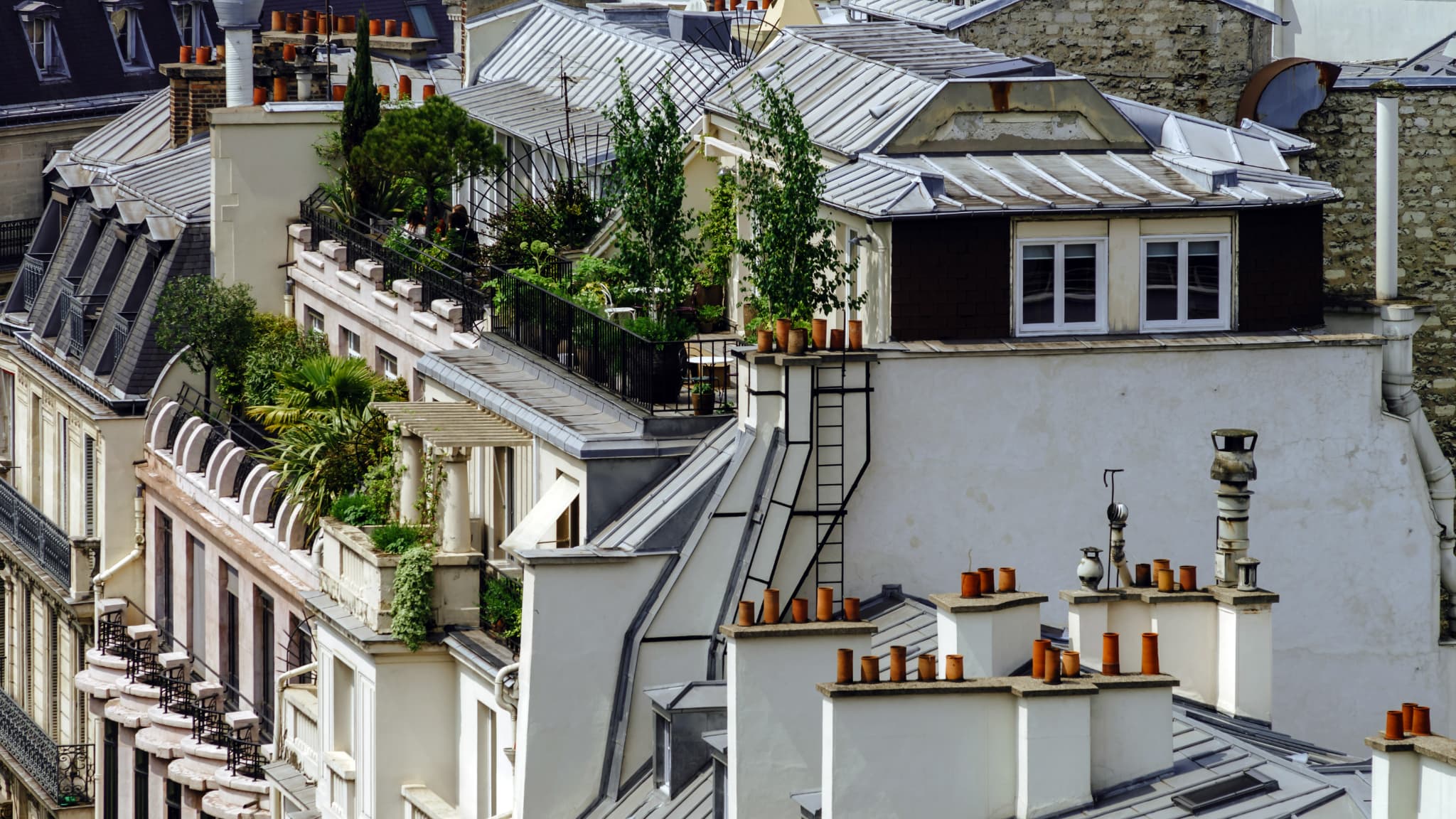
Faced with an increase in vacant housing, elected officials have introduced amendments to Budget 2025 to allow cities to increase taxes on vacant housing and second homes.
It’s not just an impression. The park of rental accommodation is decreasing year by year in the capital. According to a new estimate from the City of Paris, they have almost halved since the 1980s, going from 600,000 to 350,000* today.
Again according to municipal data, in the last 10 years the capital has lost around 8,000 rental housing units every year. At the same time, the number of free accommodati on or from second homes increases by 7,000 every year, according to INSEE.
For Jacques Baudrier, PCF housing deputy at Paris City Hall, the increase in empty housing and the decline in rental properties are directly linked. “These are the only two categories that are evolving. The number of owner-occupiers is stable and the number of houses purchased by the Municipality to transform them into social housing is around 700”, explains the elected representative.
“I therefore conclude that some multi-owners prefer to leave their property empty rather than rent it.”
Communist parliamentarians (and not only) want to stem this phenomenon. They have submitted amendments to the budget bill currently being debated in the Assembly to authorize cities to raise taxes on these vacant homes.
Only 1.3% of housing permanently vacant
The share of vacant housing in Paris increased from 14% in 2011 to 19% in 2020 according to INSEE, or almost one in five housing units. Therefore, of the almost 1.5 million homes in Paris, 270,500 are unoccupied. Half are second homes, the other half are vacant homes. Each of them represents approximately 9.5% of all Parisian homes.
“Owners can move from one category to another simply by checking a box,” explains Jacques Baudrier, who explains why they are considered together. But this does not mean that everyone can be mobilized to respond to the housing crisis, far from it. In reality you have to look at the numbers carefully.
Let’s take vacant housing first. THE’little (Paris Urban Planning Laboratory) believes that a rate of 6 or 7% corresponds to a “frictional” vacancy, that is, “a short-term vacancy necessary for the rotation of families in the private park”.
In Paris, Apur estimates that this rate is higher, due to the high mobility of families. Finally, according to INSEE, in 2021 only 18,600 housing units fall within the so-called structural availability (more than 2 years) in the capital.
It may not seem like much (1.3% of the fleet), but the agency assures that their number is not negligible in a city like Paris.
“This represents approximately 5 years of construction in a dense and consolidated city like Paris.”
Let’s now move on to second homes. Their number has in fact exploded since 2011, going from 6.8% to 9.6%. But it is impossible to know which are regularly inhabited by their owners and which are continually empty. However, INSEE notes that 42% of these homes belong to owners resident in the Île-de-France, including some in Paris.
36% of unoccupied homes in the 8th arrondissement
According to the statistics institute, in some neighborhoods the rate of vacant housing is particularly high, such as in the center of Paris (28%), in the 6th (30%), 7th (34%) and especially in the 8th arrondissement (36%).
“The unoccupied houses are concentrated in the neighborhoods where the richest families live (…) This correlation is largely due to the geographical distribution of second homes, which are concentrated in the richest neighborhoods”, writes Apur.
“If we do nothing, we will end up with a half-empty Paris,” warns Jacques Baudrier.
But then why do so many houses remain empty? Considering the explosion of purchase prices in the capital, rental investments are not profitable. And according to Jacques Baudrier, the rent control nothing changes. “For rents to be profitable in Paris, rents would have to double, so tenants wouldn’t have the means to keep up anyway,” he explains.
“These are often older people and multiple owners who bought a long time ago, don’t want to bother with renting and don’t need it financially,” assures the elected official.
A more dissuasive tax?
To try to counter this phenomenon, its teams have created a system called “Solidarity and risk-free rent”. It offers, for owners who are cautious due to unpaid potential to guarantee payment of the rent and restoration of the premises at the end of the lease. But despite these guarantees, very few have agreed to put their property back on the rental market (1,300).
“Having an apartment in Paris has become a luxury product for display, like a Rolex, much more than a rental investment,” judges Jacques Baudrier.
As sales prices evolve over the long term, these owners are still assured of a profitable operation. “Indeed, as long as the value of a property increases, it generates potential income (in case of resale) simply by holding it, and this price increase covers the cost of maintaining unoccupied housing,” Apur writes. In summary, it is not necessary to rent the property to realize added value.
According to Jacques Baudrier, not even the existing taxes on vacant housing and second homes convince owners to rent out their property. “We need a more dissuasive figure. Today they prefer to pay 2,000 euros a year rather than rent. If we get to 6,000 euros perhaps they will change their minds.” The municipality thus hopes to reintegrate up to 100,000 homes into the private rental stock.
*Figure different from the (declarative) one of INSEE, which numbers almost 500,000 (excluding public housing tenants). This is explained, according to the housing deputy of the municipality of Paris, Jacques Baudrier, by the fact that people often make mistakes when filling out the questionnaire and do not indicate that they live in an HLM. The city has an accurate count of the number of social housing units. We then deduce social housing and an estimate of undeclared tourist rentals to arrive at the number of long-term rental properties.
Short-term rentals via platforms like Airbnb are regulated in Paris. Therefore, owners can only rent out their primary residence and no more than 120 days a year. These properties are therefore not included in the 270,000 unoccupied housing units. There remain “illegal” Airbnbs, i.e. those that do not respect this rule, which the municipality estimates at 25,000. He hopes to be able to reduce this number I count which will be discussed in the Assembly in a joint commission on 28 October.